THE SCULPTOR'S ART
A COMPLETE GUIDE TO SUBTRACTIVE SYNTHESIS
THE SOUL OF SUBTRACTION: CARVING SOUND FROM RICHNESS
Imagine a sculptor standing before a block of rich, vibrant marble. The final form the beautiful statue is already hidden inside; the artist’s job is simply to remove everything that is not the statue. This, my friends, is the very soul of subtractive synthesis. We begin not with a simple sine wave, but with a complex, harmonically rich waveform like a sawtooth or a square wave and we use our tools to lovingly carve, chisel, and polish it until the sound we hear in our hearts is revealed. This journey of sculpting sound has several key stages, each with its own marvelous tools. We begin with our raw material the sound sources. Then we blend them, before moving on to the grand art of carving with filters and shaping with amplifiers. And guiding it all are the invisible hands of control voltage.
Let us begin our journey at the source

THE RAW MARBLE — OUR SIGNAL SOURCES
Every sculpture needs its block of stone. In our sonic world, this raw material comes from two primary sources: the vibrant, musical heart of the oscillator, and the chaotic, elemental hiss of the noise generator.

THE VOLTAGE CONTROLLED OSCILLATOR (VCO) — THE SINGING HEART
At the very core of our synthesizer is the Voltage Controlled Oscillator, or VCO. This is the singing heart of our machine, a generator of periodic, musical waves that cover almost the entire range of human hearing. It provides our fundamental pitch, the note upon which our entire sound is built.
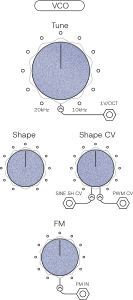

VCO tips&tricks from Leon Somov
The Bullfrog gives us two beautiful waveforms to choose from, each with its own character:
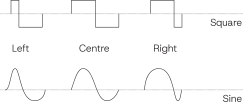
The Sine Wave: This is the purest of all waveforms, a smooth, gentle sound with no harmonics. In its pure form, it is like a flute or a tuning fork. But with the turn of the SHAPE knob, we can transform it into a “sharkfin” wave, adding a unique new character.
The Pulse Wave: This is a richer, more complex sound. At one extreme, it is a thin, reedy 10% pulse wave. In the center, it becomes a perfect Square Wave, which has a wonderfully hollow, resonant sound, much like a clarinet. And at the other extreme, it is a fat 90% pulse wave.

The TUNE knob allows us to set the fundamental pitch of our sound, but as we will soon see, the true magic comes from controlling this pitch with voltage.
And practice on web Bullfrog Synth instrument
Follow Geeky Punks
Contacts
hello@geekypunks.com